

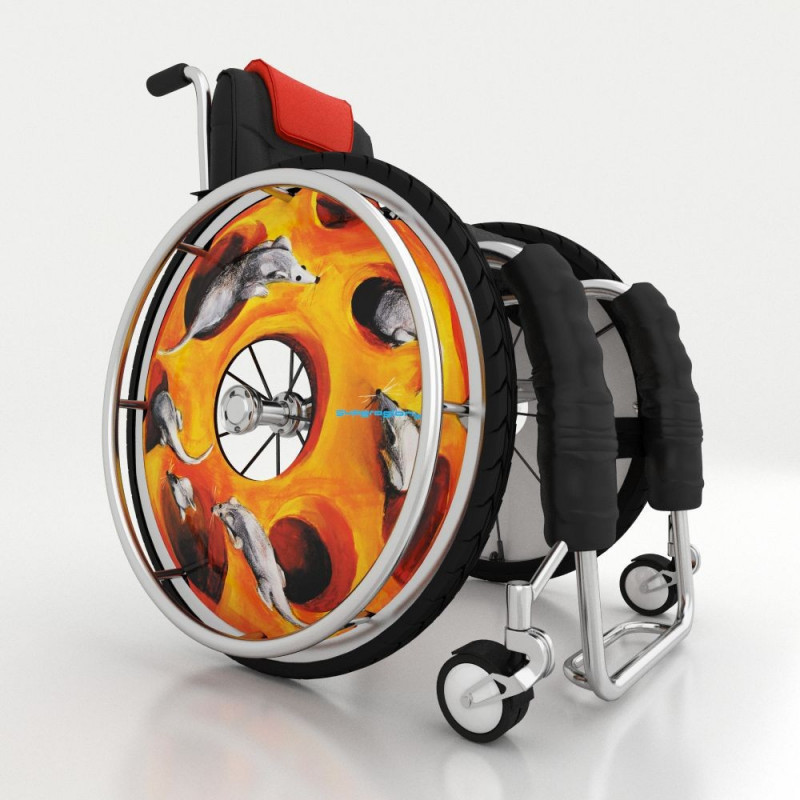
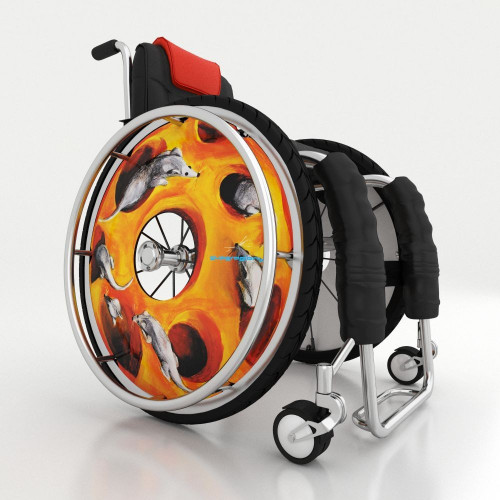
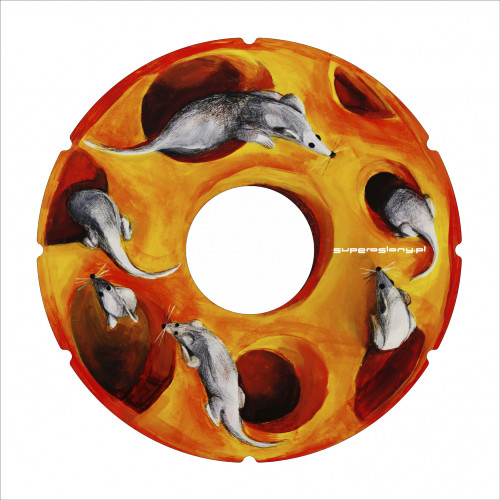
In everyday life, especially when using wheelchairs, we care about comfort and functionality, but also about ensuring our equipment reflects our personality and style. That's why we're presenting our unique graphic design – a wheelchair spoke cover that brings joy, fun, and a touch of magic to everyday moments. Our cover features playful mice enjoying yellow cheese, adding a touch of lightness and smiles to any wheelchair. It's the perfect choice for those looking to add a unique touch to their wheelchair.
Fun and adorable mice strolling around the holes in the cheese are a design sure to catch the eye and bring a smile. This light, playful design makes the spoke cover more than just a practical accessory for your wheelchair. It's a piece that brings joy and a touch of humor to your day, brightening your mood and instilling a positive attitude when you look at your wheelchair.
Cheese-munching mice are a well-known theme in pop culture and children's literature. These little rodents are associated with lightness, agility, and an innocent approach to the world. Therefore, the motif of mice cheerfully munching holes in cheese perfectly captures the spirit of optimism, lightness, and carefreeness. These illustrations are full of energy, creativity, and playfulness, making even everyday activities, such as using a wheelchair, more enjoyable and full of joy.
The colors in this graphic were chosen to maximize the impression of positive energy. The bright shades of yellow that appear against the background of the mice and cheese add warmth, joy, and optimism. The yellow cheese with its characteristic holes is an essential element of this cheerful graphic, drawing the eye and creating a pleasant contrast with the rest of the design.
The background of the cover is designed to subtly support the main motif, not overpowering it but rather highlighting the entire scene. Thanks to carefully selected colors, the cover complements most wheelchair colors, becoming an interesting yet practical addition. When you look at the cover, you'll feel like you're entering a world full of joy, humor, and fun.
Our spoke cover is not only aesthetically pleasing but also highly functional. It's designed to protect your stroller's spokes from dirt, dust, and moisture, which can affect their condition. The cover keeps your spokes clean, and your stroller maintains its performance for longer.
Additionally, the cover is weather-resistant, making it an ideal choice for everyday use – both indoors and outdoors. The cover's material is durable, flexible, and easy to attach, making installation quick and hassle-free. The cover is easy to remove and clean, further enhancing its practicality.
Funny graphics – the motif of mice eating cheese is a humorous and joyful design that will make everyone laugh and give the cart a unique character.
High-quality material – the cover is made of durable, weather-resistant materials that protect the spokes from damage and dirt.
Easy assembly and disassembly – the cover can be easily attached to the spokes and removed if necessary.
Joy and smiles – adding such a cover to your wheelchair not only protects the spokes, but also makes moving more enjoyable.
Versatility – the cover fits most wheelchairs, making it a great solution for a wide range of users.
Personalization – If you want to customize the colors or graphics to your individual preferences, we offer the option of personalizing the cover.
Our wheelchair spoke cover also makes a great gift. If you're looking to give someone you love something to cheer them up, they're sure to love this fun and functional accessory. It's a great way to highlight their wheelchair and make every moment spent moving more positive.
"Hey, hey, what are those little mice up to?" – these words best capture our philosophy, which aims to add a little fun to everyday life. Our wheelchair spoke cover featuring cheese-eating mice is the perfect option for those who want to distinguish their vehicle in a fun, creative, and humorous way. With this cover, any wheelchair will gain not only protection but also a unique, playful look that will turn heads and bring a smile. Don't wait, add some fun to your wheelchair and make getting around a pleasure!
In everyday life, especially when using wheelchairs, we care about comfort and functionality, but also about ensuring our equipment reflects our personality and style. That's why we're presenting our unique graphic design – a wheelchair spoke cover that brings joy, fun, and a touch of magic to everyday moments. Our cover features playful mice enjoying yellow cheese, adding a touch of lightness and smiles to any wheelchair. It's the perfect choice for those looking to add a unique touch to their wheelchair.
Fun and adorable mice strolling around the holes in the cheese are a design sure to catch the eye and bring a smile. This light, playful design makes the spoke cover more than just a practical accessory for your wheelchair. It's a piece that brings joy and a touch of humor to your day, brightening your mood and instilling a positive attitude when you look at your wheelchair.
Cheese-munching mice are a well-known theme in pop culture and children's literature. These little rodents are associated with lightness, agility, and an innocent approach to the world. Therefore, the motif of mice cheerfully munching holes in cheese perfectly captures the spirit of optimism, lightness, and carefreeness. These illustrations are full of energy, creativity, and playfulness, making even everyday activities, such as using a wheelchair, more enjoyable and full of joy.
The colors in this graphic were chosen to maximize the impression of positive energy. The bright shades of yellow that appear against the background of the mice and cheese add warmth, joy, and optimism. The yellow cheese with its characteristic holes is an essential element of this cheerful graphic, drawing the eye and creating a pleasant contrast with the rest of the design.
The background of the cover is designed to subtly support the main motif, not overpowering it but rather highlighting the entire scene. Thanks to carefully selected colors, the cover complements most wheelchair colors, becoming an interesting yet practical addition. When you look at the cover, you'll feel like you're entering a world full of joy, humor, and fun.
Our spoke cover is not only aesthetically pleasing but also highly functional. It's designed to protect your stroller's spokes from dirt, dust, and moisture, which can affect their condition. The cover keeps your spokes clean, and your stroller maintains its performance for longer.
Additionally, the cover is weather-resistant, making it an ideal choice for everyday use – both indoors and outdoors. The cover's material is durable, flexible, and easy to attach, making installation quick and hassle-free. The cover is easy to remove and clean, further enhancing its practicality.
Funny graphics – the motif of mice eating cheese is a humorous and joyful design that will make everyone laugh and give the cart a unique character.
High-quality material – the cover is made of durable, weather-resistant materials that protect the spokes from damage and dirt.
Easy assembly and disassembly – the cover can be easily attached to the spokes and removed if necessary.
Joy and smiles – adding such a cover to your wheelchair not only protects the spokes, but also makes moving more enjoyable.
Versatility – the cover fits most wheelchairs, making it a great solution for a wide range of users.
Personalization – If you want to customize the colors or graphics to your individual preferences, we offer the option of personalizing the cover.
Our wheelchair spoke cover also makes a great gift. If you're looking to give someone you love something to cheer them up, they're sure to love this fun and functional accessory. It's a great way to highlight their wheelchair and make every moment spent moving more positive.
"Hey, hey, what are those little mice up to?" – these words best capture our philosophy, which aims to add a little fun to everyday life. Our wheelchair spoke cover featuring cheese-eating mice is the perfect option for those who want to distinguish their vehicle in a fun, creative, and humorous way. With this cover, any wheelchair will gain not only protection but also a unique, playful look that will turn heads and bring a smile. Don't wait, add some fun to your wheelchair and make getting around a pleasure!
The motif of mice playing in cheese, known from many illustrations, comics, and animations for children, is a classic image that has brought smiles to the faces of young readers for years. These funny, clever, and energetic mice, often residing in holes in cheese, are not only charming heroines but also symbols of carefreeness, fun, and lightheartedness. Mice playing in cheese have become a permanent fixture in children's pop culture, becoming an indispensable element of books, animations, comics, and even advertising.
The motif of mice playing in cheese has a long tradition, dating back to the beginnings of children's literature and illustration. Early depictions of mice in the context of cheese were primarily intended to present these animals in a playful and yet soothing way for young readers. Mice in children's literature are most often friendly characters who don't inspire fear, but rather amuse with their agility and cunning. Using the cheese motif in conjunction with mice is a classic technique in this type of illustration, where the cheese, with its characteristic holes, symbolizes a rich environment full of possibilities and adventures in which young characters can play.
One of the first known examples of such representations is the story of mice finding hidden treasures in cheese, or of those playing in a maze of cheese holes. Although mice were most often merely a backdrop for larger stories, their presence in the context of cheese acquired an additional, symbolic dimension. Cheese, in this case, was not merely food but also a space for discovery and play.
In the 20th century, the motif of mice playing in cheese gained even greater popularity, especially thanks to the rapid development of animation and comics. The first comics introducing the motif of mice in the context of cheese appeared in the early 20th century, and the real boom of this image occurred in the 1930s and 1940s. It was then that the first animated films were created, which became a permanent part of the history of children's culture.
The most famous example from this period is the character of Mickey Mouse, created by Walt Disney. Although Mickey himself is not directly associated with cheese, in many of his adventures he was often depicted in the context of amusing, sometimes grotesque situations that could be reminiscent of mice playing in cheese. His distinctive character, full of enthusiasm and joy, set the trend for later mice in animation and comics. With the emergence of characters like Tom and Jerry , the mouse motif became a major humorous motif in many cartoons, often combining hilarious chases, jumping through cheese holes, and small, full-motion adventures that these little rodents engaged in.
At the same time, comics also appeared, featuring mice playing in a world of cheese, exploring not only underground tunnels but also a variety of adventurous stories. The mouse characters in comics were much more developed than before, often possessing human-like characteristics—talking, emotions, friendships, and even diverse personalities. These comic mice not only played in cheese but also introduced children to more complex stories about discovery and the value of friendship.
The golden age of animation and comics, which occurred in the mid-20th century, was a time when mice playing in cheese became the heroines of numerous stories and humorous situations. Cheese became a symbol of comfort, pleasure, and even safety. Cheese-munching mice were portrayed in a charming way, often accompanied by other fantasy characters such as bunnies, cats, and birds.
One of the most important events in the history of mouse-and-cheese animation was "Tom and Jerry," which gained immense popularity in the 1940s and 1950s. Although the main characters were a cat and a mouse, Tom's mouse, Jerry, was often depicted in hilarious scenes where he played in a "cheese world" full of unexpected traps. In these cartoons, none of the mice were passive participants; they were always full of energy and ready for action, ensuring that viewers couldn't take their eyes off the characters.
Contemporary illustrations, comics, and children's animations continue to draw on this classic motif. Mice playing in cheese is a popular motif in both books and television productions. Today, thanks to modern technologies, 3D animation, and computer productions, we can see mice in even more vibrant, colorful, and engaging scenes. These characters often take on the characteristics of "superheroes," using their cunning abilities to navigate cheese mazes, help other characters, and solve problems.
Contemporary children's illustrations, such as those in mouse adventure books and comics for young children, still evoke the theme of mice playing in cheese, but also introduce modern, playful touches. Mice often become heroines who teach children the value of friendship, courage, and creativity. Cheese, as the backdrop for their play, not only symbolizes pleasure but also helps create cheerful, warm, and humorous stories that children can love.